
Myth 1: My Landlord’s Policy Protects My Home Office Gear.
Honestly, this is probably the biggest misunderstanding out there. Many folks assume that because their landlord has insurance on the building, their personal belongings—especially their expensive home office setup—are somehow covered. Not true. Not even a little bit.
Your landlord’s insurance policy? That’s for the building itself. Think of it: the walls, the roof, the plumbing, maybe even the appliances *they* own that came with the place. If a pipe bursts and damages the drywall, that’s on them. But if that burst pipe also drenches your brand-new, top-of-the-line Mac Studio, a couple of high-res monitors, and your fancy ergonomic chair? That’s all on you.
Renters insurance is designed specifically for your stuff. It covers your furniture, your clothes, your electronics, and yes, your entire home office setup. It’s your safety net. Without it, you’re footing the bill for replacements if disaster strikes. And in a place like California, where everything from wildfires to water damage can happen, that’s a pretty big gamble.
So, What Does Renters Insurance Actually Cover?
Beyond protecting your personal property from things like theft, fire, or certain types of water damage, renters insurance offers a few other really important protections.
First, there’s personal liability. Say a client or a delivery person for your business slips and falls on your porch in Ventura County. If they decide to sue you for medical bills and lost wages, your renters policy can help cover legal fees and settlement costs. That’s a huge deal. You’re inviting people into your space, even if indirectly through deliveries, and accidents happen.
Then there’s additional living expenses, sometimes called “loss of use.” Imagine a fire rips through your apartment in the Inland Empire, making it unlivable. Where do you go? What about your income if you can’t work? This part of your policy can help pay for a hotel, temporary housing, and even extra food costs while your place is being repaired. It means you can keep your business running, even if you’re temporarily displaced. That’s not just a convenience; it’s often a necessity for a remote worker.
Myth 2: My Regular Renters Policy Is Enough For My Business Equipment.
The short answer is yes. The real answer is more complicated. A standard renters insurance policy *does* cover personal property, and your home office equipment *is* personal property. But here’s where it gets interesting: most policies have specific, often low, limits for business property when it’s located *at your home*.
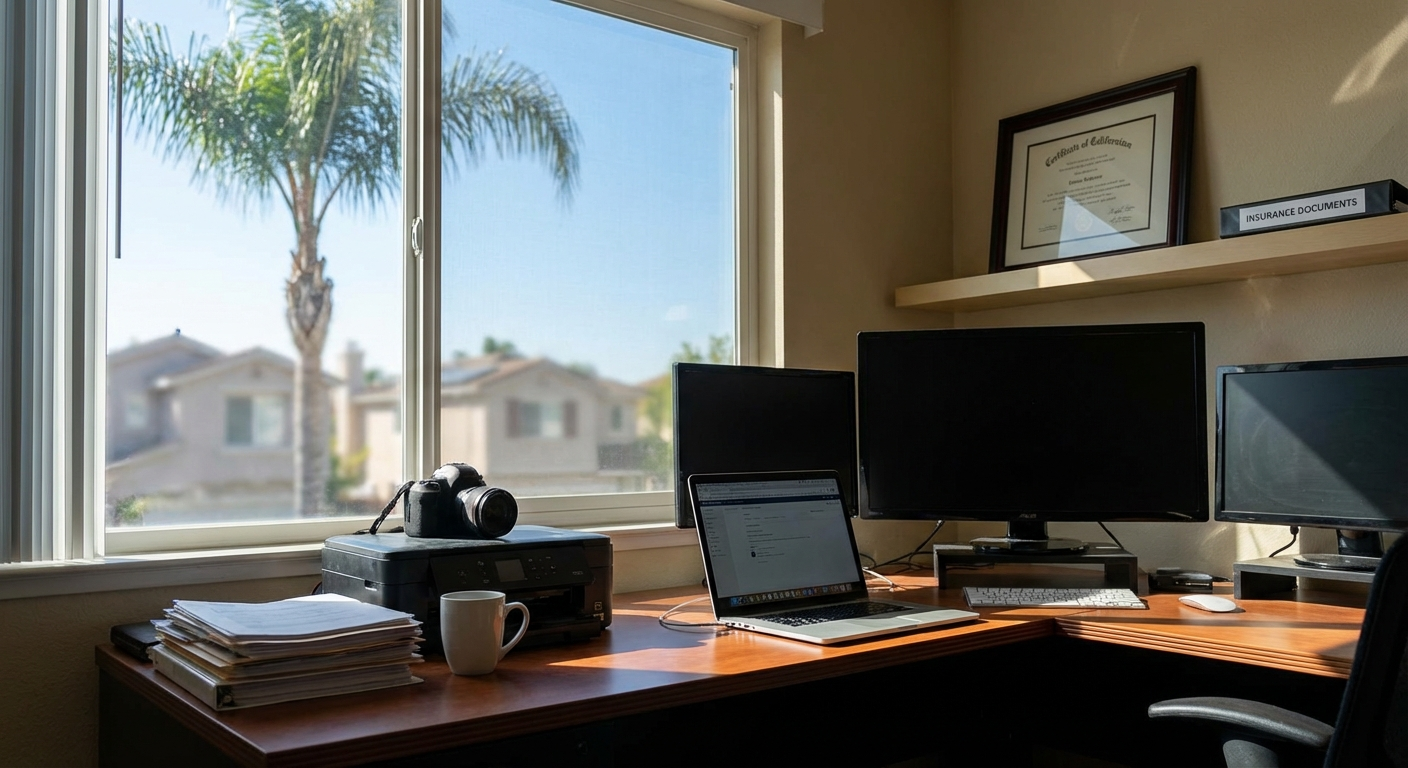
Think about it this way: your policy might cover up to, say, $2,500 for business equipment. That might sound like a lot if you’re just using a basic laptop and a printer. But in today’s remote work world, especially here in California, that amount vanishes fast. A high-end desktop computer alone can easily cost $3,000 or more. Add a couple of professional monitors, a specialized keyboard, a fancy microphone for video calls, a powerful printer, and maybe some photography or design equipment? You’re quickly looking at $5,000, $10,000, or even more.
If your home office equipment is stolen or destroyed in a fire, and its total value is $8,000, but your policy only covers $2,500 for business property, you’re out $5,500. That’s a tough pill to swallow.
What Kind of Equipment Are We Even Talking About?
This isn’t just about a laptop anymore. For many Californians, working from home means a serious investment in technology. We’re talking about:
* Powerful desktop computers and laptops
* Multiple large, high-resolution monitors
* Specialized software licenses
* High-quality webcams and microphones for virtual meetings
* Printers, scanners, and shredders
* Ergonomic desks and chairs
* External hard drives and backup systems
* For creatives: professional cameras, lighting kits, audio recording gear, graphic tablets
* For developers: multiple servers, specialized testing equipment
Every single one of these items represents a financial investment. And every single one is vulnerable to theft, fire, or accidental damage. Many people in places like Silicon Valley or the tech hubs of Los Angeles have home offices that rival small commercial setups. Ignoring those limits is a risky game.
Myth 3: Business Insurance Covers Everything I Need.
This is another common misconception, especially for freelancers or small business owners who’ve already gone the extra mile to get a business policy. You might have a general liability policy or even some coverage for your business equipment *when it’s away from your home office*. But that doesn’t always translate to comprehensive protection for the gear sitting in your spare bedroom in Orange County.
Often, business policies are designed for commercial spaces or for equipment that travels with you to client sites. They might have a high deductible for claims involving property at your home, or they might not cover certain perils that a renters policy would. There’s often a gap between what a standard business policy covers and what a renters policy with the right add-ons can protect in your home office.
Which brings up something most people miss. You might need a specific endorsement on your renters policy called a “home-based business endorsement” or you might need to “schedule” individual high-value items. Scheduling means listing specific items and their values with your insurer. This bypasses the general business property limits and ensures those expensive items are fully covered. It’s the difference between hoping for the best and knowing you’re protected.
Myth 4: It’s Too Expensive To Get The Right Coverage In California.
Let’s be real: California is expensive. Housing, gas, groceries—it all adds up. So, it’s natural to think that renters insurance, especially with extra coverage for your home office, will cost an arm and a leg. But here’s the thing: renters insurance is surprisingly affordable, even with those crucial endorsements.
We’re not talking about hundreds of dollars a month. Often, a good renters policy with a home-based business endorsement can cost less than your daily coffee habit. When you compare that modest cost to the thousands of dollars it would take to replace your entire home office after a fire or theft, it’s a no-brainer. Think of it as a small, smart investment in your peace of mind and your livelihood.
Honestly, finding the right fit doesn’t have to break the bank. Karl Susman at Affordable Renters Insurance California, CA License #0B75129, has helped countless Californians figure this out. A quick chat can clarify a lot. He’s seen the premiums jump across the board for homeowners, but renters insurance has remained a budget-friendly way to protect your assets. A quick chat can clarify a lot.
Ready to see what it takes to protect your digital workspace? You can get a tailored quote for California renters insurance, including specific coverage for your home office equipment, right now. It’s a smart move for anyone working from home: Get Your Renters Insurance Quote
Myth 5: I Only Need To Worry About Theft.
While theft is a very real concern, especially for portable, high-value electronics, it’s far from the only threat to your home office. In California, we live with a unique set of risks.
Consider fire. The threat of wildfires is a constant worry for many communities, from the hills of Malibu to the wildland-urban interface near Sacramento. A fire can wipe out everything in an instant. But even inside a city apartment, an electrical fire, a kitchen mishap, or a careless neighbor can send smoke and flames through your unit, destroying your entire workspace.
Water damage is another big one. A burst pipe in an upstairs apartment, a leaky roof during one of our atmospheric rivers, or even an overflowing sink can quickly ruin computers, monitors, and important documents. Most standard renters policies will cover damage from sudden and accidental water discharge.
Then there’s accidental damage. Did you knock over a glass of water onto your laptop? Did your cat decide your monitor was a new scratching post? While standard policies might not cover every single “oops” moment, some endorsements can extend coverage to accidental damage for specific, scheduled items.
And don’t forget the liability aspect we talked about. If your home office means more foot traffic—even just delivery drivers for your business supplies—the risk of someone getting hurt on your property goes up. Your renters policy is your first line of defense against those claims.
What About Earthquakes or Floods?
It’s true that standard renters policies generally don’t cover damage from earthquakes or floods. These usually require separate, specialized policies. However, the focus for home office equipment is often on the more common perils like fire, theft, and water damage, which *are* covered by a good renters policy. If you’re in an earthquake or flood zone, it’s definitely worth discussing those additional coverages with an agent.
Okay, So How Do I Actually Get This Coverage?
It’s simpler than you might think.
First, take an inventory of your home office equipment. Go through every item, note its make, model, and estimated value. Take pictures. Keep receipts if you have them. This list will be invaluable if you ever need to file a claim.
Next, talk to an independent insurance agent. Someone like Karl Susman at Affordable Renters Insurance California (CA License #0B75129, phone (877) 411-5200) can walk you through the specifics. They work with multiple insurers like State Farm, AAA, and Farmers, so they can compare options and find the best fit for your needs and budget. You’re not tied to just one company’s offerings.
When you talk to them, specifically ask about coverage for your home office equipment. Mention if you run a business from home, even if it’s just a side gig. Ask about “scheduled personal property” for your most expensive items and a “home-based business endorsement” to boost those general limits. You’ll also want to understand the difference between “replacement cost” (which pays to replace your old item with a new one) and “actual cash value” (which factors in depreciation). For electronics, replacement cost is almost always the better choice.
Protecting your livelihood shouldn’t be an afterthought. Your home office is a serious investment, and a smart renters insurance policy is the best way to safeguard it.
Ready to secure your workspace and your peace of mind? Don’t wait until it’s too late. Get a personalized renters insurance quote tailored to your California home office needs right now: Get Your Renters Insurance Quote
Frequently Asked Questions
Does my renters policy cover my work laptop provided by my employer?
Generally, no. If your employer provides you with a laptop, it’s typically their property. Therefore, their business insurance policy would be responsible for covering it if it’s damaged or stolen. You should confirm this with your employer, but don’t assume your renters policy will step in.
What’s the difference between Actual Cash Value and Replacement Cost for my equipment?
This is a big one. Actual Cash Value (ACV) pays you the depreciated value of your item. So, if your five-year-old computer is stolen, you’d only get what it was worth right before it was taken, not what it costs to buy a new one. Replacement Cost (RCV), on the other hand, pays to replace your old item with a brand-new one of similar kind and quality. For electronics, RCV is almost always the better option, even if it costs a little more in premiums.
If I accidentally spill coffee on my work computer, is it covered?
A standard renters policy typically covers specific perils like fire, theft, and certain types of water damage, but not usually accidental damage like spilling coffee. However, you can often add an “all-risk” or “scheduled personal property” endorsement for your high-value items, which can extend coverage to accidental damage. It’s definitely worth discussing this specific scenario with an agent.
Do I need to list every single item in my home office?
For most of your general items, like a standard desk or basic printer, you don’t need to list every single one. These fall under your general personal property coverage. But for high-value items—think that $4,000 camera, specialized audio equipment, or a custom-built PC—you absolutely should “schedule” them. This means listing them individually on your policy with their specific values to ensure they’re fully covered beyond the standard limits.
This article is for informational purposes only and does not constitute financial advice.